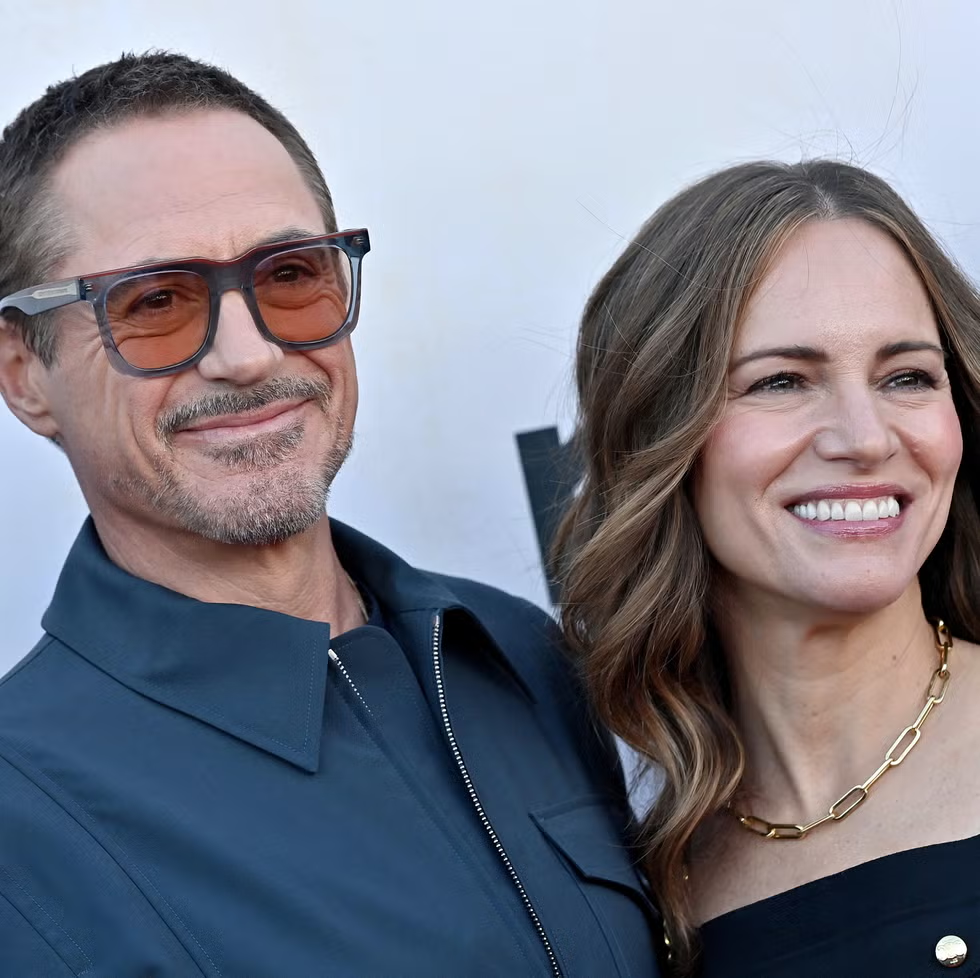
Robert Downey Jr wife news has been dominated recently by his repeated public acknowledgments of Susan Downey’s role in his career resurgence and personal stability. During his Oscar acceptance speech, SAG Award remarks, and multiple red carpet appearances, Downey has credited his wife not just with support but with fundamental transformation. The phrase “she loved me back to life” has become the defining narrative of their relationship, repeated across interviews and award speeches.
That consistency of message isn’t accidental. Susan Downey, a film producer who met Downey on the set of “Gothika,” has been positioned publicly as the person who made his sobriety and career comeback possible. The narrative is compelling, redemptive, and carefully maintained. But it also places significant weight on one relationship and one person, which creates both opportunity and risk for how their partnership is understood publicly.
The Strategy Of Gratitude As Career And Personal Brand Foundation
Downey’s public acknowledgments of his wife serve multiple functions simultaneously. They reinforce his sobriety narrative, humanize him in contexts where he’s being celebrated for professional achievement, and position his marriage as the cornerstone of his stability. That framing has been consistent for years, not just during recent award season appearances.
From a brand perspective, this creates a specific kind of equity. Downey’s story is one of fall and redemption, and Susan is presented as the essential catalyst for that redemption. The repetition across speeches and interviews builds a narrative that’s easy for audiences to understand and emotionally satisfying. It’s a love story, a recovery story, and a success story rolled into one.
The risk, of course, is that this narrative reduces Susan’s professional identity to her role in Downey’s recovery. She’s an accomplished producer with her own career and credits, but the public framing often positions her primarily as the person who saved Downey. That dynamic can be limiting, even as it’s intended to be honoring.
How Professional Partnership Reinforces Personal Narrative And Brand
Susan and Robert Downey founded Team Downey, their production company, in 2010. That professional partnership means they’re not just married, they’re business collaborators. The decision to work together creates additional visibility and reinforces the narrative that their relationship is foundational to both their personal and professional lives.
From a practical standpoint, joint business ventures tie a couple’s public profiles together in ways that go beyond personal appearances. Projects produced by Team Downey carry both their names, and the company’s success or failure impacts both their reputations. That interdependence can be advantageous when things are going well, but it also means there’s no professional separation if the relationship were to falter.
The reality is that celebrity couples who work together face unique pressures. The personal and professional become inseparable, which can strengthen the partnership or create points of tension that wouldn’t exist otherwise. For the Downeys, the professional collaboration has been framed as evidence of their strong partnership, not a source of strain.
The Pressure Of Sustained Public Narrative And Maintaining Consistency
Downey has been delivering versions of the same message about his wife for over a decade. The phrasing varies, but the core narrative remains consistent: Susan gave him an ultimatum about sobriety, he got clean, and their relationship has been the foundation of his success ever since. That level of consistency is unusual and strategic.
What I’ve learned from observing how public figures manage personal narratives is that consistency matters more than novelty. Downey doesn’t need to find new ways to describe his wife’s impact; repeating the same essential message reinforces it. The audience doesn’t get tired of it because the context keeps changing, new awards, new speeches, new projects.
But there’s a limit to how long any narrative can sustain interest without evolution. At some point, the story of recovery and redemption becomes background rather than foreground. The couple has been married for nearly two decades, and while that longevity is impressive, it also means the dramatic arc of early recovery has flattened into stable, long-term partnership.
The Context Of Family And How Children Reshape Visibility Priorities
The couple has two children together, and Downey has acknowledged them publicly in ways that suggest family has become a greater priority as his career has stabilized. During his SAG Award speech, he specifically shouted out their son, dedicating the award to him. That shift from focusing solely on his wife to including their children reflects a broader evolution in how he talks about his personal life.
From a reputational standpoint, expanding the narrative to include his role as a father adds dimension to how Downey is perceived publicly. He’s not just the recovered addict or the successful actor, he’s also a parent navigating the challenges of raising children in a high-profile environment. That adds relatability and complexity to his public profile.
The challenge with family-focused narratives is that children, especially young ones, have privacy needs that adults may not. The couple has been relatively protective of their children’s exposure, sharing selective information but not making them central to public appearances or content. That balance between acknowledgment and protection is difficult to maintain consistently.
Why Award Season Visibility Reinforces Long-Term Relationship Stability
Downey’s recent sweep of major awards for his role in “Oppenheimer” provided multiple high-profile platforms to discuss his wife and their relationship. The repetition of gratitude across the BAFTAs, SAG Awards, Golden Globes, and Oscars created a sustained narrative arc that went beyond any single speech. Susan appeared with him at each event, providing visual reinforcement of the partnership.
That kind of sustained visibility during a compressed timeframe amplifies the message in ways that occasional appearances don’t. The couple was photographed together repeatedly, Downey spoke about her in nearly every acceptance speech, and the media coverage consistently framed their relationship as central to his success. The cumulative effect was significant.
Here’s what actually works: leveraging high-visibility moments to reinforce core narratives about personal relationships. Downey used award season not just to celebrate professional achievement but to publicly recommit to the narrative about his wife’s essential role in his life. Whether that narrative fully captures the complexity of their relationship is unknowable from the outside, but as a public framing strategy, it’s been remarkably effective and consistent over time.